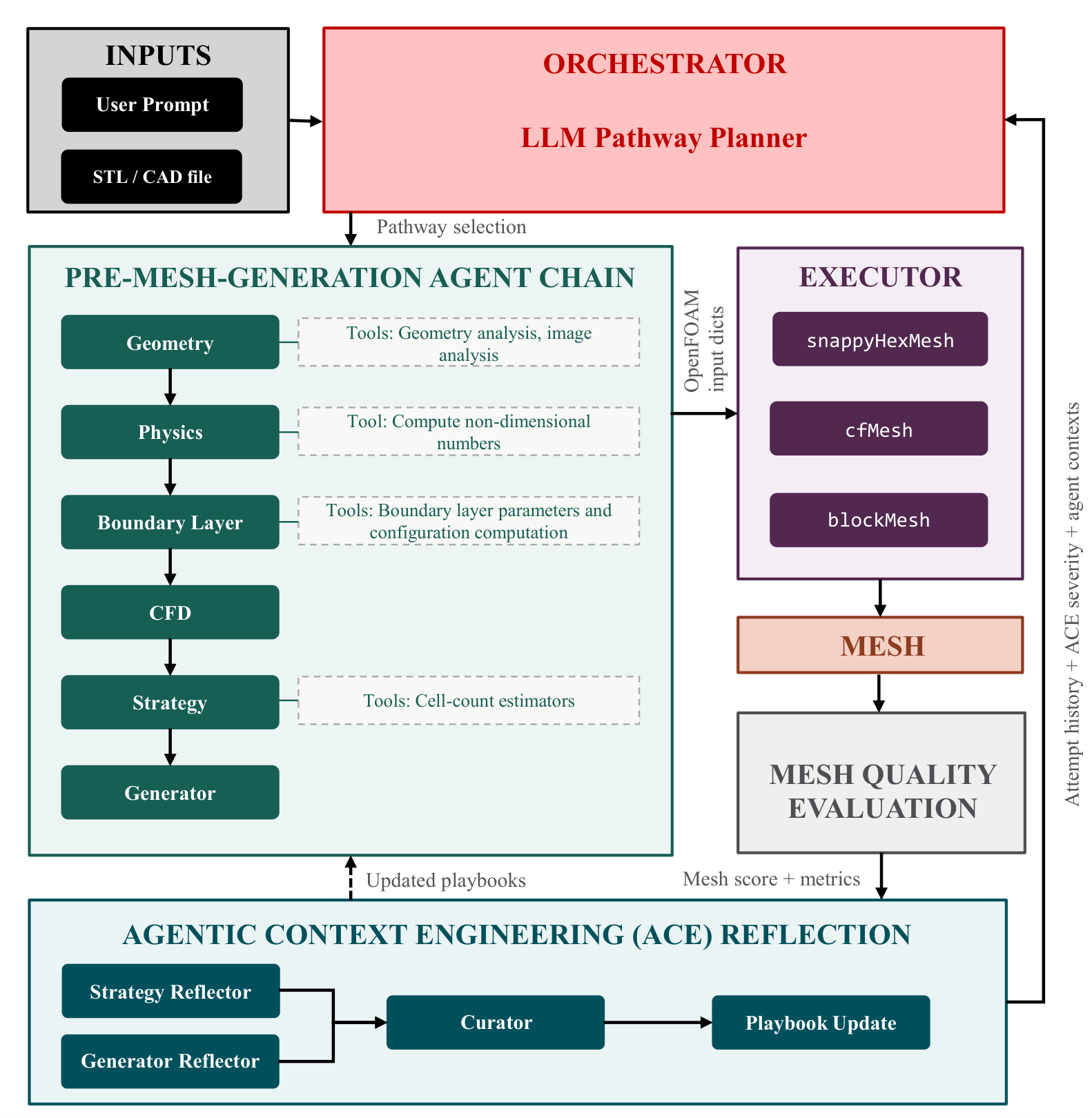
Six specialized LLM agents chained into a single pipeline, with deterministic tools called at every stage of the reasoning process.
The VortexAI pipeline. A chain of six LLM agents (center) progressively transforms user requirements and geometry into mesh configuration files, invoking deterministic computational tools at each stage. An executor runs the target OpenFOAM backend (snappyHexMesh, cfMesh, or blockMesh). An automated quality evaluation layer scores each mesh on element quality, boundary-layer coverage, and generation success. The ACE reflection cycle (right) analyzes the execution outcome through two independent reflectors (one for strategy, one for implementation) and distills findings into updated playbook rules that feed back into the next attempt. An orchestrator (top) selects which agents to re-execute based on reflector severity, skipping upstream stages when only local fixes are needed.
Six specialized LLM agents execute in sequence, each consuming the structured output of the previous one:
Geometry agent. Classifies surfaces, identifies flow-relevant features, and measures characteristic length scales from the STL/STEP file.
Physics agent. Determines the flow regime, assigns boundary types, and identifies off-body regions that need targeted refinement (separation zones, wakes, shear layers).
Boundary-layer agent. Computes first-layer cell height, growth ratio, and layer count from the target y⁺ and upstream flow data.
CFD agent. Translates the physics context into discretization requirements: per-boundary cell sizes, layer parameters, solver recommendations, and a global cell budget.
Strategy agent. Converts CFD requirements into a backend-specific meshing plan with quantitative parameters. Calls a cell-count estimator to verify budget compliance before finalizing.
Generator agent. Writes the actual OpenFOAM configuration files (blockMeshDict, snappyHexMeshDict, etc.) from the strategy. On retries, it receives previous files and error diagnostics for targeted fixes.
Each agent can invoke deterministic computational tools during reasoning, grounding its decisions in quantitative analysis rather than relying on the LLM's parametric knowledge alone.